


Looking for YouTube ad examples that feel useful instead of recycled? The best YouTube ads rarely win because of one flashy edit. They win because the first seconds are clear, the promise is easy to understand, and the viewer knows what to do next.
This guide gives you 15 YouTube ad examples and ready-to-adapt templates for ecommerce, apps, services, courses, events, and creator products. You will also learn how to turn a template into a finished concept with insMind's YouTube ad maker, using either a product image or a text prompt.
Table of Contents
What Makes the Best YouTube Ads Work?
Before you write or generate a video, choose the job of the ad. Are you trying to introduce a new product, retarget warm shoppers, teach a quick feature, or drive trial signups? That choice decides which youtube video ad template will work best.
| Ad Goal | Best Template Type | Suggested Length | Best Format |
|---|---|---|---|
| Cold audience awareness | Problem-solution, founder story, social proof | 15-30 seconds | 16:9 or 9:16 |
| Product education | Demo, tutorial, app walkthrough | 20-45 seconds | 16:9 |
| Fast recall | Bumper, offer countdown, one-line benefit | 6-15 seconds | 16:9 or 9:16 |
| Conversion retargeting | Review, objection handling, comparison | 15-30 seconds | 16:9, 1:1, or 9:16 |
How to Turn One Template into Many Ads
The fastest creative teams do not build every ad from scratch. They take one good YouTube video ad template and create controlled variations. Change one major element at a time so you can learn what actually improves performance.
- Change the hook: Try a question, a bold claim, a customer quote, and a visual before-and-after.
- Change the audience: Rewrite the same product benefit for beginners, busy parents, creators, students, or small businesses.
- Change the format: Make a 16:9 in-stream version, a 9:16 Shorts version, and a 6-second bumper cut.
- Change the proof: Test a review, demo result, comparison point, statistic, or founder explanation.
- Change the CTA: Compare "Shop Now," "Try It Free," "Book a Demo," "See the Difference," and "Start Creating."
If your campaign is mobile-first, pair these examples with a dedicated YouTube Shorts creator workflow so the composition feels native to vertical viewing.
15 YouTube Ad Examples and Templates
Need inspiration you can actually use? The following youtube ad examples are written as repeatable campaign patterns. Each one includes a concept, why it works, and a plug-and-play template you can adapt for your next ad.
1. The Problem-Solution Opener
This is one of the best youtube ads for products that solve an obvious pain. Start with the viewer's problem, show the product in action, then close with the specific outcome.
Template: Open with a close-up of [pain point] happening in real life. Say: "Still dealing with [specific frustration]?" Cut to [product] entering the scene, then show one clear action that solves the problem. Add an on-screen benefit such as "[main result] in [timeframe]" and end with "[CTA]" while the product stays visible.
2. The Six-Second Bumper
A bumper ad cannot explain everything, so it should own one idea. Use a visual punch, a product name, and a memorable benefit.
Template: Use one fast visual: [product/person/result] appears immediately. Voiceover or text: "[Product] helps [audience] get [benefit]." Add a memorable three- to five-word tagline, then close on the logo, product, or offer screen with a simple CTA like "Shop Now," "Try Free," or "Book Today."
3. The Product Demo Close-Up
For ecommerce, a close-up demo often works better than abstract storytelling. Show texture, scale, packaging, use, and result in a tight sequence.
Template: Start with the product in hand or on a clean surface. Show Step 1: [first action], Step 2: [second action], and Step 3: [visible payoff]. Keep each shot short and label it with two or three words. End with "[product] is built for [audience] who want [benefit]" plus your CTA.
4. The Founder Story
Founder-led youtube video ad examples are useful when trust matters. Keep the story short and tie it to a customer problem, not a company timeline.
Template: Put the founder on camera or use a founder-style voiceover over brand visuals. Say: "I started [brand] after seeing [problem]. We built [product] to help [audience] [benefit] without [old frustration]." Show the product proof, then close with a warm CTA: "See why we built it" or "Try it today."
5. The UGC-Style Testimonial
This format feels personal and direct. Use natural language, quick proof, and a clear before-and-after statement.
Template: Film or generate a casual creator-style clip. Start with: "I tried [product] because I was tired of [problem]." Show the product being used in [daily situation], then add: "The biggest difference was [specific result]." End with a natural recommendation: "If you want [benefit], this is worth trying."
6. The Before-and-After Transformation
This example works for beauty, fitness, editing tools, home products, and productivity apps. Make the contrast visual enough that viewers understand it without sound.
Template: Split the ad into two clear halves. First show "Before [product]" with [messy, slow, dull, or frustrating situation]. Then transition to "After [product]" with [clean result, faster workflow, improved look, or happier user]. Add a short proof line and finish with "Make the switch in [simple action]."
7. The Limited-Time Offer
Offer ads work when the value is concrete. Avoid vague urgency and use a real discount, deadline, bonus, or bundle.
Template: Open with the offer, not the brand story: "For [time window], get [discount/bonus/bundle] on [product]." Show the product solving [use case] in two or three quick shots. Add the deadline visually near the end, then close with "Claim [offer] before [date]" and a direct CTA.
8. The Side-by-Side Comparison
Comparison youtube ads examples help viewers decide. Focus on the decision criteria that matter, such as speed, ease, price, quality, or flexibility.
Template: Show [old way] on the left and [product/new way] on the right. Label the contrast with concrete points: [time saved], [cost reduced], [steps removed], or [quality improved]. Voiceover: "[Old way] takes [friction]. [Product] helps you [better outcome]." End with "Choose the faster way to [goal]."
9. The Mini Tutorial
A tutorial ad teaches before it sells. It is especially strong for software, creative tools, education, and workflow products.
Template: Start with a tutorial hook: "Want to [goal] without [pain]?" Show three labeled actions: [step 1], [step 2], [step 3]. Keep the screen or product action visible while each label appears. End with the finished result and say: "With [product], you can do this in [timeframe]."
10. The Shorts-First Hook
Some of the best youtube video ads are built for vertical viewing first. Open with motion, a bold visual change, or a question that fits mobile behavior.
Template: Build for vertical first. Frame the subject large, open with movement, and use a first-line hook like "Stop scrolling if you [identity/problem]." Show one bold result within the first three seconds. Keep text big, cut quickly, and close with "[product] helps you [benefit] in [short timeframe]."
11. The Retargeting Reminder
Retargeting ads do not need to reintroduce everything. Remind viewers what they looked at, answer a final objection, and make the next step easy.
Template: Speak to warm viewers directly: "Still thinking about [product]?" Remind them of the main benefit, then answer one objection such as price, setup time, quality, or trust. Add proof: [review, rating, guarantee, demo, or result]. Close with "Come back and [CTA]" or a limited return offer.
12. The Social Proof Stack
If your product has reviews, press quotes, ratings, or customer numbers, stack them visually. Keep each proof point short enough to read on mobile.
Template: Stack three proof moments in order: [customer count or rating], [short review quote], and [visible product result]. Keep each proof point on screen for just long enough to read. Voiceover: "[Number] customers use [product] to [goal]. Rated [rating] for [reason]. Join them today."
13. The Seasonal Campaign
Seasonal ads give viewers a timely reason to act. Tie the product to a moment: back to school, holidays, summer travel, graduation, or a product launch window.
Template: Anchor the first frame to [season/event] with a visual cue like gifts, travel, school supplies, summer light, or launch graphics. Say: "This [season/event], make [task] easier with [product]." Show the benefit in action, then close with "Get [benefit] before [occasion/date]."
14. The App Walkthrough
For apps and SaaS tools, show the interface only when it clarifies the benefit. Pair each screen with a user outcome, not a list of buttons.
Template: Show the app workflow as a short story, not a feature list. Screen 1: open [app] and choose [feature]. Screen 2: add [input] or select [option]. Screen 3: preview [result]. Pair each screen with a benefit caption, then end with "Built for [audience] who need [benefit]."
15. The Local Service Trust Ad
Local service ads need credibility quickly. Use location, service, proof, and availability in the first half of the video.
Template: Start with a local search-style hook: "Need [service] in [city/area]?" Show the team, location, tools, or finished result. Add trust proof such as [years in business], [rating], [license], [before-after], or [customer quote]. End with "Book [consultation/quote/appointment] today" and show the phone, form, or website.
How to Create YouTube Ad Examples with insMind
Once you have a template, you need a fast way to visualize it. insMind lets you create AI video generator concepts from text prompts, product images, or reference visuals, so you can test different hooks before committing to a full shoot.
Step 1: Open the YouTube Ad Maker
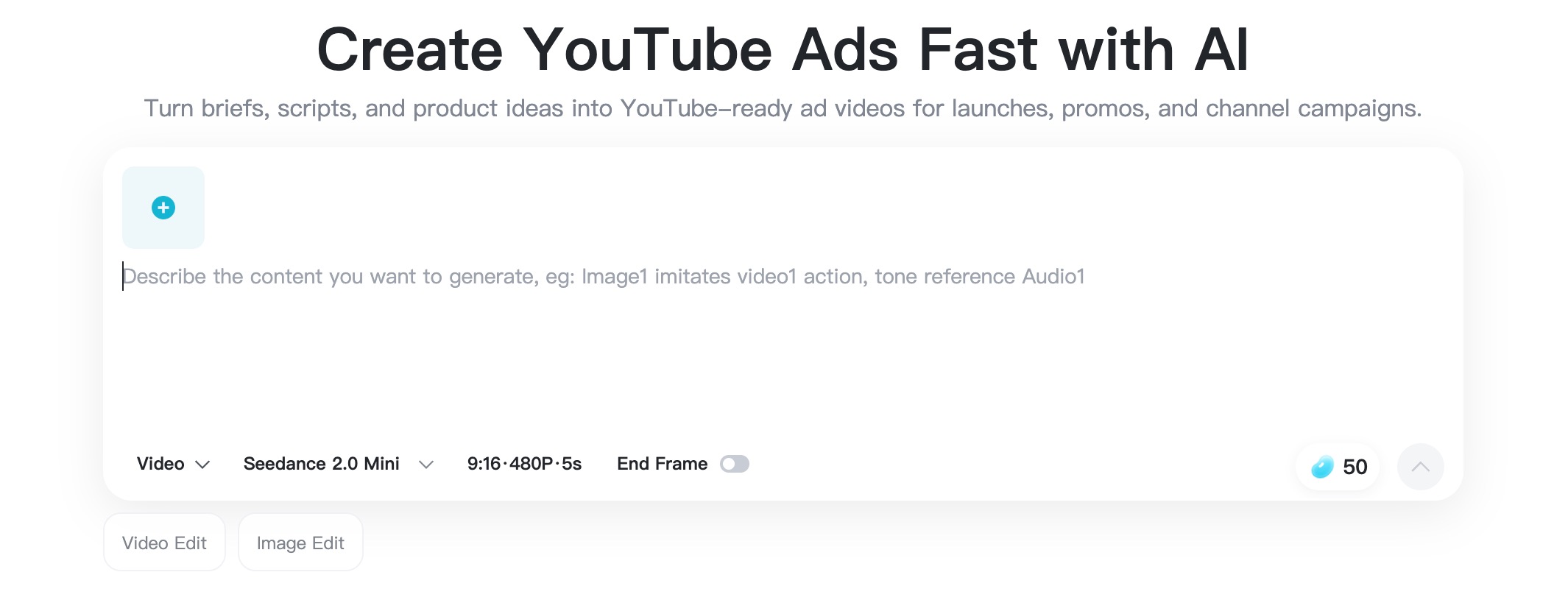
Go to insMind's YouTube Ad Maker and start a new ad concept. If you already have a product photo, packaging shot, logo, or lifestyle reference, upload it so the video has a clear visual anchor.
Step 2: Add Your YouTube Ad Template Prompt
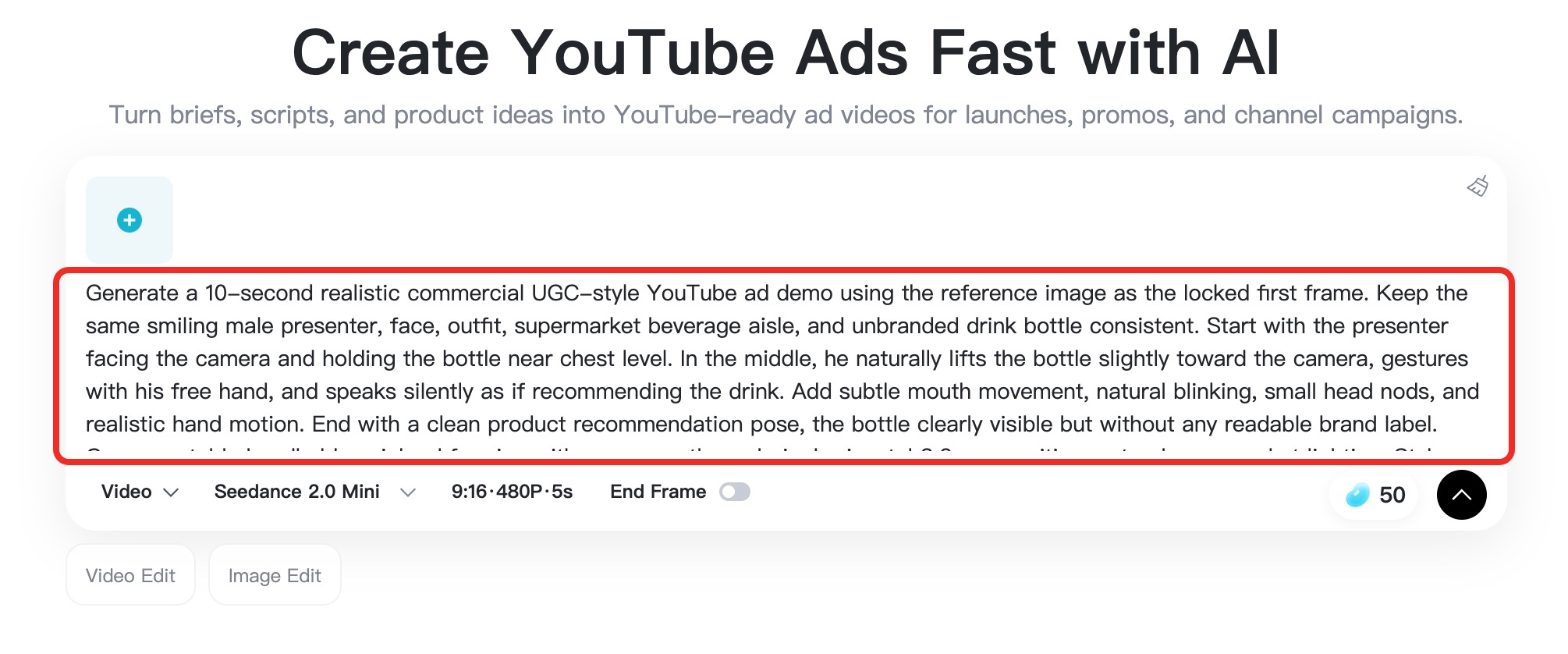
Paste or rewrite one of the templates above as a full prompt. Include your product, target viewer, opening hook, main benefit, visual style, tone, call to action, aspect ratio, and duration. For example: "Create a 15-second 16:9 skincare ad for busy professionals. Open with dry morning skin, show the serum bottle in use, highlight lightweight hydration, and end with 'Refresh Your Routine'."
Step 3: Generate and Review the First Draft
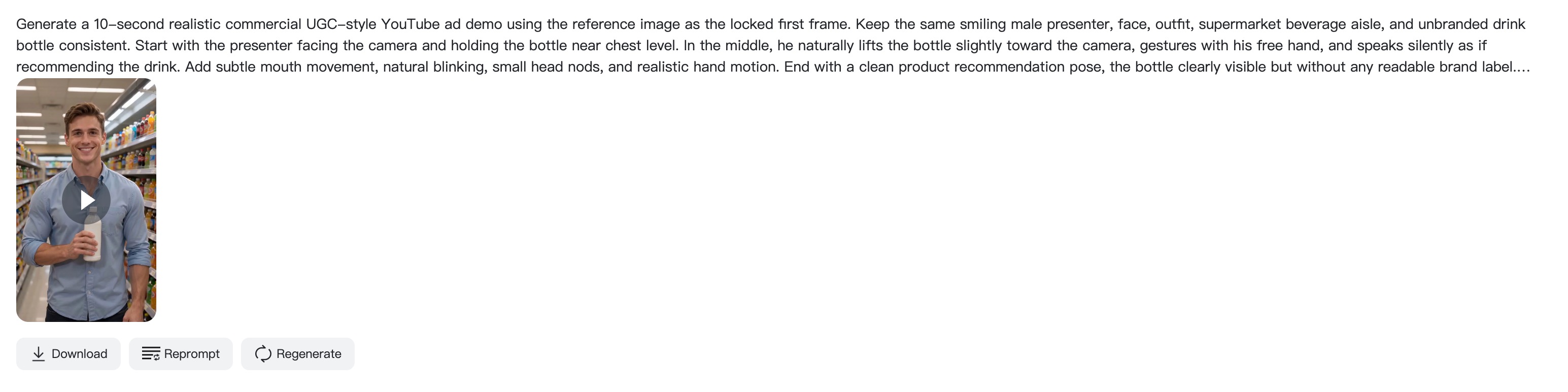
Click Generate and review the result like a media buyer would. Does the first frame communicate the product? Is the hook clear before the five-second skip point? Can the benefit be understood on a small screen?
Step 4: Refine, Download, and Test
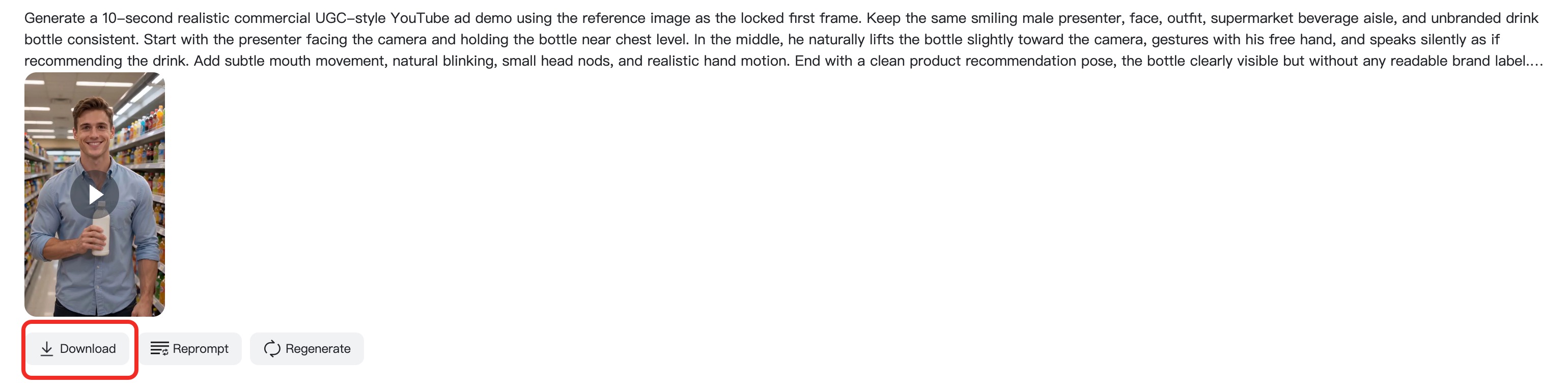
If the ad needs stronger motion, a faster opening, a clearer CTA, or a different format, adjust the prompt and generate another version. Download the best cut, then test it as a skippable in-stream ad, bumper, Shorts version, or retargeting creative.
FAQs About YouTube Ad Examples and Templates
What are the best YouTube ad examples to start with?
Start with problem-solution, product demo, UGC testimonial, and retargeting reminder formats. These templates are easy to adapt because they connect a viewer need with a clear outcome and CTA.
What should a YouTube ad template include?
A strong YouTube ad template should include the audience, hook, problem, product, proof, benefit, format, duration, and call to action. If you leave those out, the generated video may look attractive but feel unfocused.
How long should YouTube video ads examples be?
For many campaigns, 15-30 seconds is a useful starting range. Use six seconds for bumper recall, 9:16 for Shorts-style ads, and longer cuts only when the viewer needs a demo or explanation.
Can I use one template for different YouTube ad formats?
Yes, but you should rewrite it for each placement. A 16:9 in-stream version can explain more, while a Shorts version needs faster motion, larger text, and a hook that works immediately on mobile.
Can insMind make YouTube ads from a product image?
Yes. Upload a product or reference image, write a clear prompt, generate a draft, then refine the result until the hook, pacing, and CTA match your campaign goal.

Jayson HarringtonI am the Chief Editor of insMind. I provide tips and skills to help users design better photos with insMind, whether for e-commerce, social media, or any other use.


