


 Jayson Harrington·July 27, 2026
What makes someone stop scrolling? Usually, it is not a louder discount. It is a clear visual idea delivered in the first second, followed by a message that feels written for that viewer. The strongest Instagram ad examples use one tension, one proof point, and one easy next step.
That is useful whether you are a solo shop owner testing a new product, a marketer refreshing paid social creative, or a creator turning a launch into Reels. This guide collects 15 original Instagram ad ideas across feed, Stories, Reels, and carousel formats. You will also see Instagram ad copy examples and headline patterns you can adapt today.
When you want to move from a static product photo to motion, insMind’s Instagram ad maker gives you a focused workflow: choose a visual direction, describe the movement, set the output, and generate a ready-to-test clip.
What High-Converting Instagram Ads Have in Common
Before collecting more references, look for the pattern underneath them. A useful ad makes the value obvious without asking the viewer to decode a busy scene.
- A thumb-stopping opening: a close-up, contrast, surprising action, or direct question in the first frame.
- One visual promise: show the result or the moment immediately before it.
- Readable hierarchy: a short headline, a supporting detail, and one call to action.
- Native pacing: vertical framing, captions for sound-off viewing, and a quick payoff.
- A measurable action: shop, learn, save, sign up, or send a message.
15 Instagram Ad Examples and Creative Ideas
Use these as starting points, not scripts to copy. Swap in your product, audience, proof, and brand voice. The mix includes Instagram Story ad examples, carousel concepts, and video-first ideas for Reels.
Open the box on camera
Start with a sealed package in a tight close-up so the viewer instantly understands that something new is about to be revealed. Then open it in one smooth motion, keep the product centered, and add a short benefit line while the item is still in frame. A good reveal should feel like a tiny story arc, ending with a CTA that sounds natural rather than forced and leaves the viewer wanting one more look.
Show the transformation
Lead with the honest starting point and make the after state feel earned by using the same angle, lighting, and framing in both shots. A simple split-screen, swipe, or match cut helps the change read instantly, especially on mobile. This style works well whenever the result is the main selling point and the viewer needs proof fast, because the visual contrast does more work than a long explanation.
Make the friction familiar
Open on a pain your audience already knows, like a cluttered desk, a slow setup, or a routine that eats time. Once the problem feels familiar, introduce the product as the easy answer and show the relief happening on screen. The better this is grounded in a real moment, the less you have to push the claim with copy, because the viewer can see the improvement for themselves.
“I tried this for seven days”
Frame the ad as a small experiment with clear day markers, a visible result in the middle, and a candid wrap-up at the end. The appeal is that it feels like a person reporting back, not a brand making a speech. If the tone is honest and slightly messy, the final recommendation lands with more trust and more personality, which is often what makes the viewer keep watching to the last frame.
Turn features into a visual list
Give each benefit its own shot and keep the rhythm tight enough that the sequence feels like a list the viewer can follow without reading too much. You can use words like lighter, faster, easier, or quieter, but the footage should still do most of the work. End by bringing the product back for one clear next step, so the ad does not feel like a disconnected feature montage.
Let the customer lead
Place a real customer quote over footage or a short UGC clip and let the sentence do the heavy lifting. The strongest version is specific: what changed, how fast it changed, and why it mattered. Keep the words exact, keep permission in place, and use motion only to guide attention rather than decorate the proof, so the testimonial still feels like a person speaking rather than an ad copy trick.
Teach one useful move
Choose a single useful action and show it from start to finish in three compact beats: setup, use, and result. A mini tutorial earns attention because it gives the viewer something practical even if they do not buy right away. That also makes it more saveable, which is a quiet but very useful signal for Instagram ads and a nice way to build value before the click.
One question per card
Make the first card carry the question, then use the next cards to answer it with evidence, side-by-side detail, or a short demonstration. Keep each slide focused on one idea so the swipe feels smooth instead of cluttered. The final card should close the loop with the offer and a clear reason to click now, which keeps the carousel feeling like one argument instead of a loose stack of slides.
Challenge a category assumption
Open with a belief your audience may already hold, such as that the product is too expensive, too technical, or too time-consuming. Then answer that objection with one concrete fact or visual proof, not a bigger-sounding slogan. The tension makes the opening stronger, and the clarification keeps the ad from drifting into hype, which matters if you want the ad to feel credible instead of clever for its own sake.
Make the deadline concrete
Pair the close-up with an actual end date, quantity, or launch time so the urgency is easy to understand at a glance. This style works best when the terms are readable and accurate, because urgency loses power the moment it feels fuzzy. Keep the copy clean and let the timing do the persuasive work, so the pressure feels clear but still trustworthy enough for a paid placement.
Show the making
Use quick cuts of tools, materials, hands, or packing to give the product some texture and process. The point is not to show everything, but to make the viewer feel that real work and care went into the item. Finish with the finished product in a real setting so the process feels connected to the purchase decision, not like a random montage that only exists to fill time.
Answer the objection
Start with the question the viewer is likely already asking, such as whether it fits, how long it lasts, or whether it is hard to use. Then answer it visually in the next beat with a measurement, demonstration, or practical use case. The format is simple, but that simplicity is exactly why it is useful for Instagram Story ad examples, especially when you want a fast answer and a clean path to the next step.
Own the moment
Build the ad around a holiday, weather shift, school season, or other moment that gives the viewer a reason to care today. The trick is to make the mood timely without making the benefit disappear next week, so the creative still holds up later. A good seasonal ad feels relevant first and promotional second, which helps it slide into the feed without looking like it was built only for a sale window.
Combine real clips with polish
Open on raw customer footage so the ad feels native, then move into a cleaner product shot or branded motion beat for the finish. That contrast is useful because it keeps the ad human while still clarifying the offer. Secure permission, keep the customer voice recognizable, and let the polish support the proof instead of replacing it, so the final cut still feels like a real recommendation rather than a costume.
Show a second job
Show a surprising but credible second way to use the product, then return to the normal use so the idea does not feel gimmicky. The novelty earns the first glance, but the follow-up proof is what makes the concept memorable and believable. It is a neat way to stretch one product into a fresh Instagram ad angle without forcing a new offer, and it often gives you a stronger hook than a generic product shot.
Want to turn one of these concepts into motion? A short AI video generator workflow can help you test several hooks without reshooting every variation.
Copy and Headline Formulas for Instagram Ads
Good visuals still need a clear promise. These Instagram ad copy examples are deliberately short so they survive small screens and fast scrolls.
| Use case | Headline pattern | Copy example |
|---|---|---|
| New product | Meet your new ___ | Meet the everyday bag that keeps up. |
| Problem / solution | Still struggling with ___? | Still losing time to setup? Start in minutes. |
| Proof | Loved by ___ | Loved by 10,000 first-time creators. |
| Offer | Get ___ before ___ | Get free shipping before Friday. |
| Curiosity | The ___ trick nobody told you | The five-second product photo trick nobody told you. |
For Instagram ad headline examples, aim for five to eight words and put the outcome first. “Look polished in one click” is easier to scan than “Our latest editing technology is now available.” Avoid stacking a headline, a discount, three emojis, and a long URL in the same frame.
How to Make an Instagram Ad with insMind
These four steps match the current Instagram ad maker workflow. Use a product photo or a concise text direction, then keep the first generation focused on one motion and one message.
Choose a starting visual
Open the Instagram ad maker and select the video creation mode that fits your asset. Upload a clear product image for image-led ads, or start with a text description when you are exploring a concept from scratch.
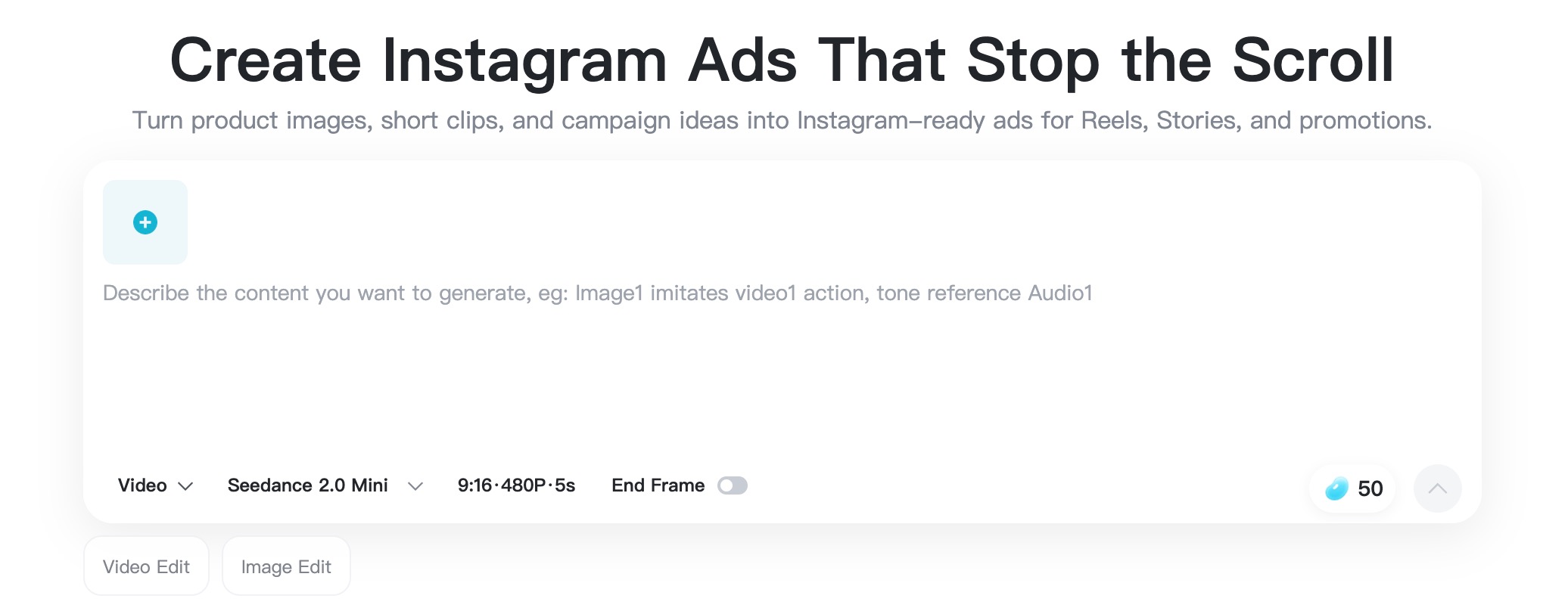
Default operation image: choose an image-led or prompt-led starting point.
Describe the movement and hook
Write a focused prompt that names the subject, action, camera move, lighting, and mood. For example: “Close-up of a silver water bottle on a gym bench; camera slides right as condensation catches the light; clean energetic fitness ad.” Keep the visual promise aligned with your headline.
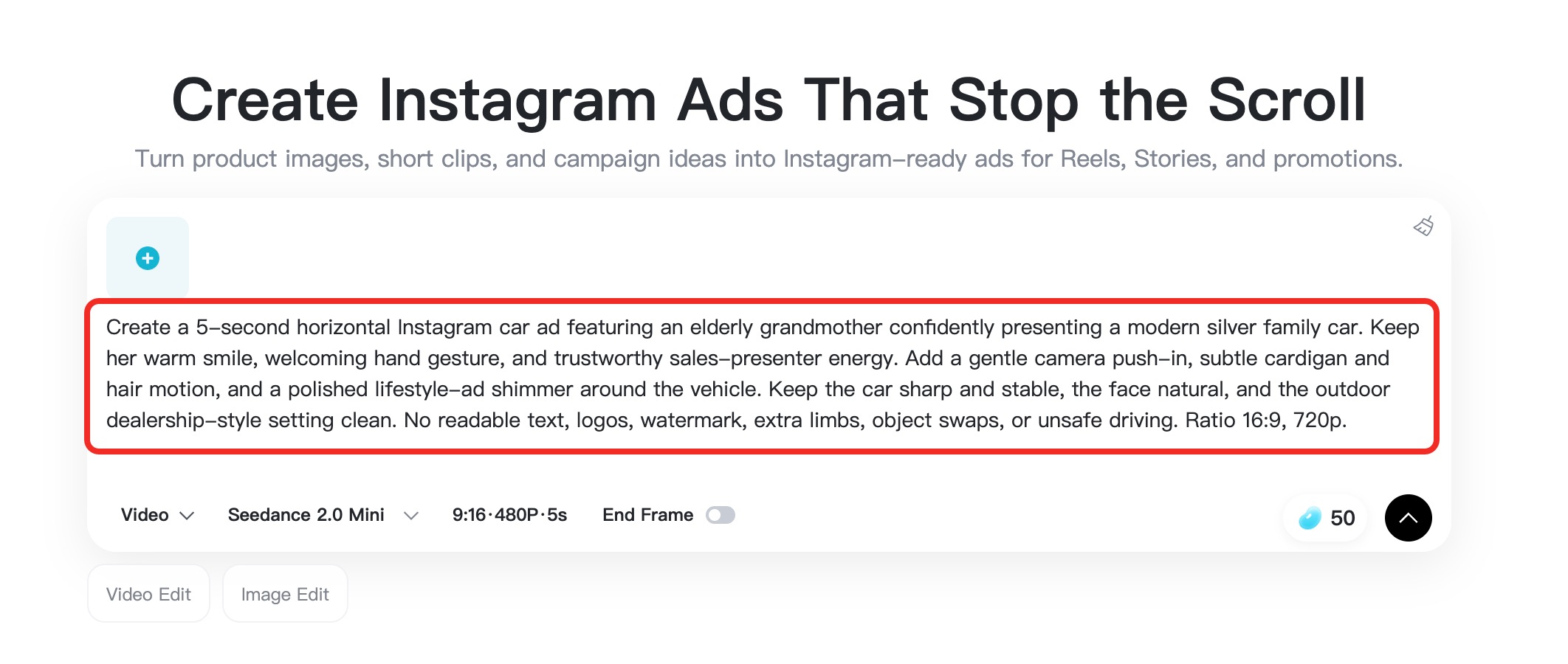
Default operation image: enter the product action, camera direction, and ad mood.
Set the Instagram output
Open video settings and choose the model, vertical 9:16 aspect ratio, duration, and quality available in your workspace. Vertical framing is the practical default for Reels and Stories; keep key text and the product away from the interface safe zones.
Default operation image: select format, duration, model, and quality before generating.
Generate, review, and download
Click Generate and inspect the clip at full size. Check product shape, hands, logos, text legibility, and the first-second hook. If the motion is too busy, shorten the prompt and regenerate; when the result is clean, download it for your caption and placement tests.
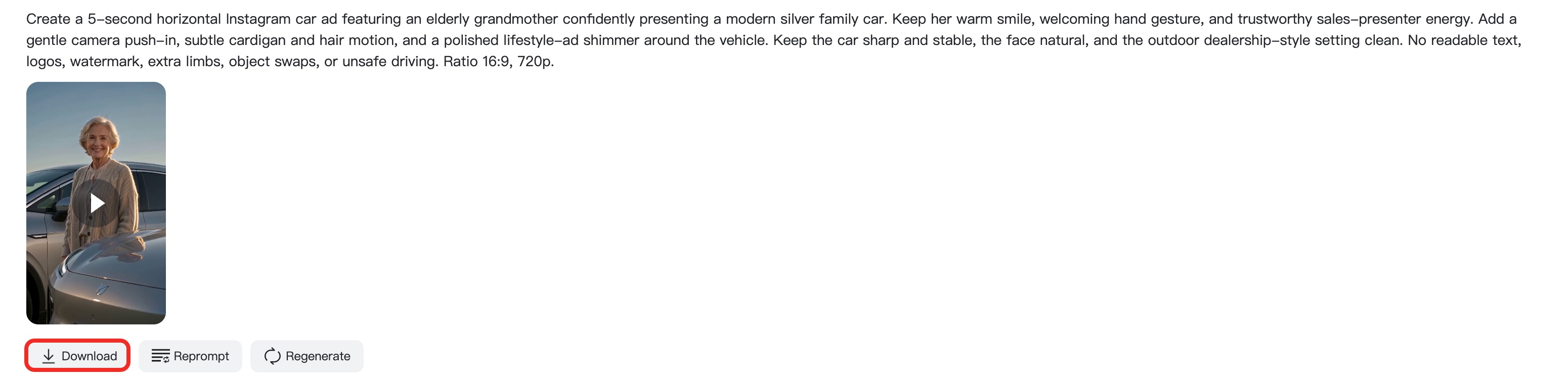
Default operation image: review the generated clip and download the version ready for testing.
Format, Testing, and Launch Checklist
One idea can become several placements. Export a 9:16 cut for Stories and Reels, then make a 1:1 or 4:5 adaptation for feed when the composition allows it. For carousels, create a consistent cover frame so the swipe sequence feels like one story.
Test the variables that change decisions
- Hook: product reveal versus a direct question.
- Proof: customer quote versus a measurable result.
- CTA: “Shop now,” “See how,” or “Save this idea.”
- Length: a tight six-second cut versus a slower 12-second explanation.
Change one major variable per test. Otherwise, you will know which ad won but not why. Track thumb-stop rate, three-second views, saves, click-through rate, and conversion rate together; a cheap click is not useful if the landing page does not convert.
FAQs About Instagram Ad Examples
What is a good Instagram ad example for a small business?
A simple problem-and-solution video or a behind-the-scenes product reveal usually works well. It feels specific, needs little footage, and gives you a clear result to measure.
How are Instagram ads examples different from regular posts?
An ad has a deliberate objective and audience, so the hook and call to action are clearer. A regular post can build community without asking for an immediate action.
Can I make Instagram carousel ads with video?
Yes. Treat each card as one beat of the story. Use the first card to earn the swipe, keep one claim per card, and reserve the final card for the next step.
What makes Instagram Story ad examples feel native?
Use vertical framing, short captions, quick cuts, and a conversational opening. Leave visual breathing room around the top and bottom interface areas.
Does insMind create the caption and ad targeting?
insMind helps you create the visual video asset. You still write the final caption, choose your audience, set the budget, and publish through Meta Ads Manager.
How many Instagram ad ideas should I test first?
Start with three distinct hooks for the same offer. Once one earns stronger attention, create two or three iterations that refine that winning direction.
I am the Chief Editor of insMind. I provide tips and skills to help users design better photos with insMind, whether for e-commerce, social media, or any other use.


